

ClearPath Navigation
Collaborators
Falak Khurmi
Timeline
6 weeks
Prangan Kashyap
Scope
Product Design
User Research
Shreya Kohli
Overview
How can navigation apps be more inclusive?
There’s been a 178% increase in the prevalence of Autism Spectrum Disorder in the US since 2000. ASD is a developmental disorder that affects social communication and interaction. Individuals on the spectrum need a reliable and accessible way to navigate as traditional navigation applications fail to accommodate their special needs hampering their mobility and independence.
My Role
I led the conceptualization and prototyped interactions
I led the project’s conceptualization and prototyped core interactions, translating research on ASD navigation challenges into testable solutions like landmark-based directions and route-change warnings
Problem
Navigation Applications fail to accommodate individuals on the ASD Spectrum
Users with ASD may struggle to navigate with Google Maps as they have difficulty with spatial concepts, which can make 2D maps seem abstract and confusing. Additionally, unpredictable situations, such as rerouting or missed turns, can cause anxiety, making the whole experience feel stressful.

Solution
ClearPath is a navigation app that helps individuals with autism and learning disabilities navigate safely through the town.
The solution was designed in the form of a mobile application called ClearPath that attempts to make individuals with ASD self-reliant and independent. Rather than give a 2D overview of the navigation path, the app provides the user with an Augmented View and gives visual cues throughout the navigation while also highlighting important information such as street signs and traffic signals


Design Process
We made sure the user needs shape every decision
We used the Double Diamond Process and PRICPS framework (Blevis,2012) to guide the design process. The Double Diamond method enhances the project by promoting thorough exploration and iteration, ensuring a well-rounded understanding of user needs and efficient problem-solving. It systematically guides divergent and convergent thinking for a more effective and user-centric design process

The user group was narrowed down to users on the ASD Level 1
For this project, the focus was on individuals who are high-functioning on the Autism Spectrum Disorder (Level 1), and are also mobile, but suffer from learning disabilities.

User Research
We conducted User Interviews with 5 users
Interviews were conducted regarding lifestyle and daily navigation practices with 4 users and 1 professional. We found out the apps they use and any special methods they adopt to make navigation easier for them.


We built an Affinity Map from interviews, academic papers, and documentaries to identify key themes.
The Affinity Map was made based on the insights gathered from primary research (interviews with the user and an expert in the field) and secondary research (academic papers and documentaries about the topic). The following themes were identified.
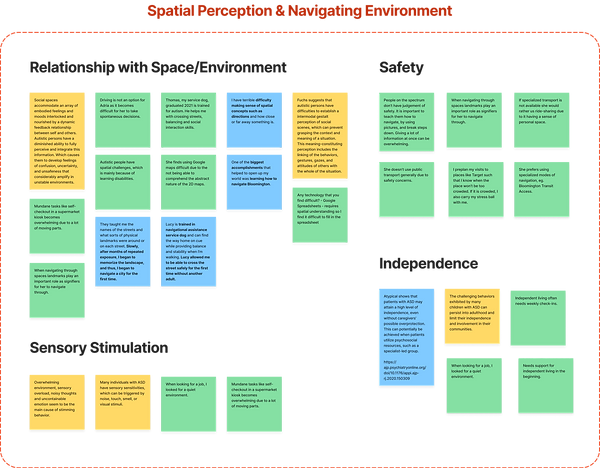



We identified the following User Needs

Core values that guided our designs
Independence
Independence is a crucial value for autistic people as it allows them to live a self-determined life, make their own choices, and pursue their interests without being overly reliant on others. It empowers them to develop their skills, gain confidence, and find their place in the world.
Consistency
Consistency and routines are important values for autistic people as they provide a sense of structure, predictability, and stability in their lives. They can help reduce anxiety, increase comfort levels, and improve overall functioning and well-being.
We conducted a Market Analysis to understand what products are currently being designed for users with ASD
Brain Power
Brain Power is a company that has developed an AR platform called Empowered Brain that is designed to help individuals with autism improve their social skills and independence.
Empowered Brain is delivered through a pair of smart glasses that use augmented reality technology to provide real-time feedback and support.
Floreo
Floreo is a VR platform that provides therapy for individuals with autism through immersive experiences. The platform has various modules that aim to improve social communication, daily living, and vocational skills.
Conceptualization
We came up with 3 concepts that could potentially solve the problem
Concept 1
How Might We develop effective guidance and routines that can be repeated to provide individuals with ASD a sense of predictability and reduce anxiety in unpredictable situations?
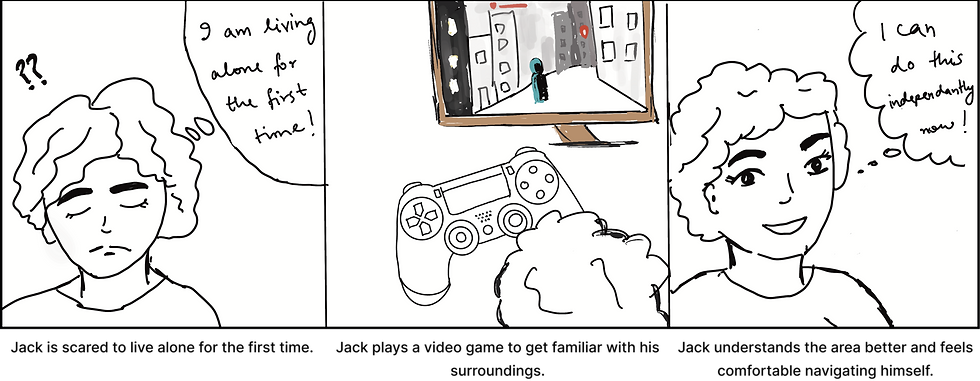
The game lets users practice daily tasks like cooking, laundry, and grocery shopping, making errors and learning through repetition
Feedback
The game should be used as a supplement to traditional learning methods, rather than a replacement so that users can apply the skills they learn to real-life situations.
Concept 2
How Might We develop tools that address the unique spatial challenges faced by individuals with ASD?

The AR app guides users with ASD to their destination using audio and visual cues that adapt to the scenario, delivering information in small chunks to avoid overstimulation.
Feedback
Sensory overload in busy or crowded environments should be considered.Users should have the ability to adjust settings or turn off certain features as needed.
Concept 3
How Might We incorporate visual cues that effectively communicate information to individuals with ASD, in order to enhance their comprehension and understanding of various situations and tasks?

The app lets users journal good and bad moments from their commutes to learn their routes and avoid unpleasant ones.
Feedback
This acts as a tool to track user experiences and emotions in a meaningful way. Users might find the app helpful in recalling paths or routes they have taken, especially in unfamiliar environments, which can help to reduce anxiety or stress.
Why did we go with AR Navigation
We decided to proceed with AR technology because it offers individuals with autism a simpler way to interact, without completely isolating them from external interactions, unlike other concepts such as gamification or VR technologies.
Visual Design
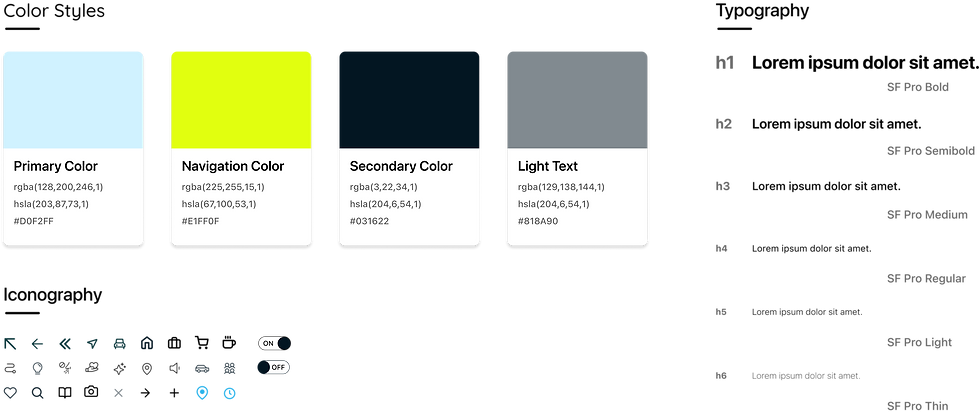
Research suggests that using soft, calm, and dark colors can help individuals with autism focus and concentrate for longer periods.
Individuals with autism often experience sensory sensitivities, including color sensitivity that can trigger anxiety or discomfort. To accommodate this, we have ensured that our app's text has a color contrast ratio of at least 4.5:1.
Research conducted by GA Architects suggests that using soft, calm, and dark colors in interior design can help individuals with autism to focus and concentrate for longer periods. We have incorporated this insight into our app design by using colors from this palette, especially for the background, to promote a focused and calming environment.
In addition, we have implemented a visual design style called Glassmorphism during the navigation phase that emphasizes a relaxed, light, and soft aesthetic to reduce visual strain and enhance the user experience during navigation.

Final Design
The final design focused on three important themes

Personalization
Accessibilty
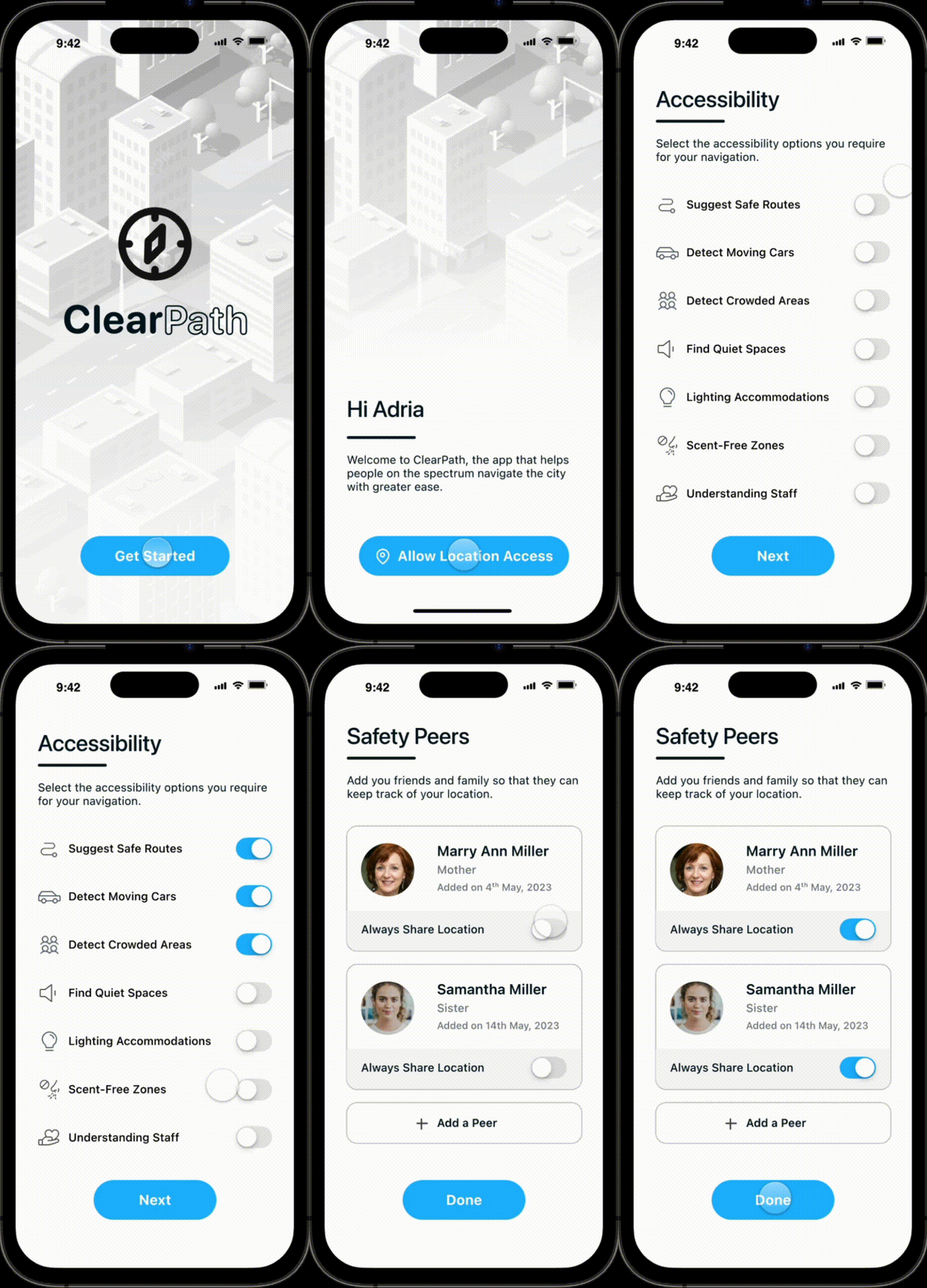
During onboarding, the users can toggle sensory filters as per their needs and fill out their peers’ information for location sharing. The design is intentionally minimal so as to not overstimulate the user.
Forming Routines
Scheduling
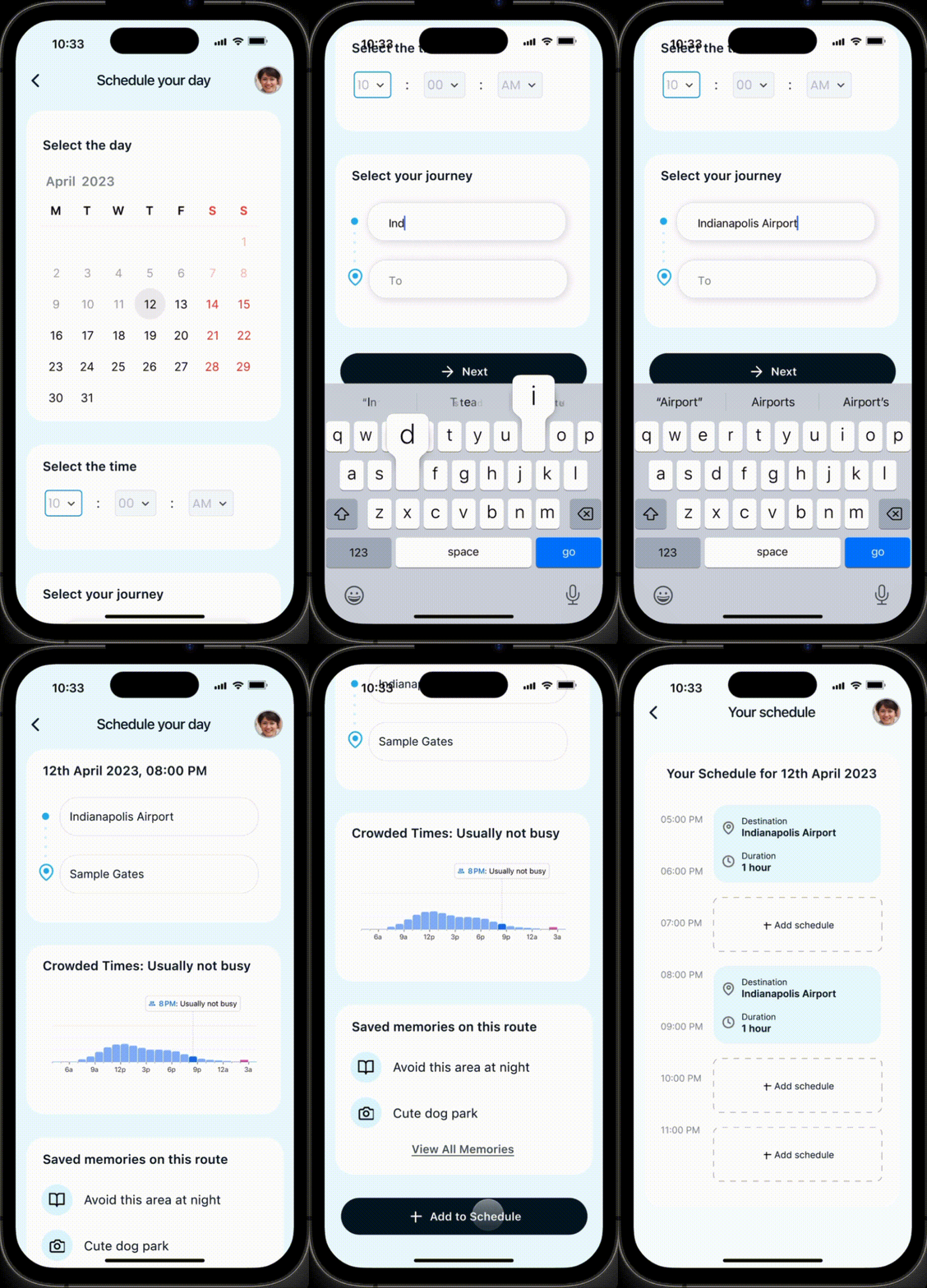
Users can schedule their days that allow users to plan their journeys in advance, helping with predictability. Furthermore, the app provides users with key information relevant to their specific trip, based on their preferred date and time. By leveraging this information, users can make more informed decisions about their travels.
Spatial Navigation
AR Navigation
The app enables users to search for their desired location and gives them an option to choose their route based on the footfall of the area. They can also see the saved trip notes which gives them comfort taking that route. During navigation, the app analyzes the surroundings and provides augmented reality feedback to guide users throughout their journey.
Familiarization
Capturing moments
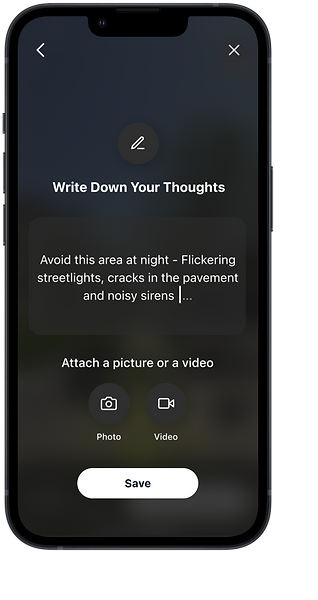
The app enables users to create detailed trip notes during their journeys. These notes can take the form of text, images, or audio recordings, and serve as visual reminders of places the user has visited. By reviewing their trip notes, users can easily recall important details and landmarks from their previous journeys when traveling along the same route in the future.
User Testing
Upon User Testing, the users suggested some improvements that could be made
Alternate Routes
We recognized the importance of providing users with multiple options for reaching their destination and thus incorporated a feature that enables them to access alternative routes.
Toggle View
We added an alternate view option that aims to eliminate distractions by minimizing the details of the surrounding buildings by defocusing them using monotone overlays, which can help the user focus on the task at hand.


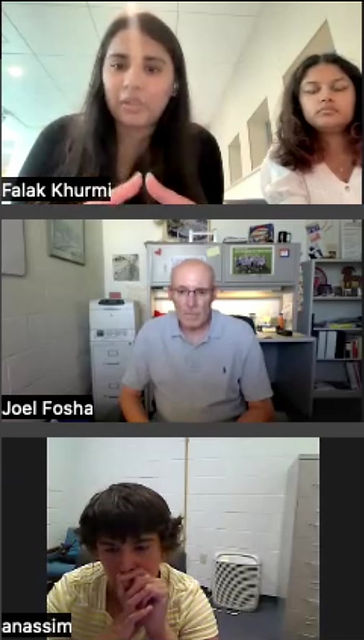
Watch ours users using the app for the first time
What the potential users had to say
“You’re telling me, this app right here can like tell when there’s no cars and tell you to go? This is like something out of Harry Potter! Wow, this is cool! ”
Wrapping up
Reflecting on the project
-
Autism spectrum disorder (ASD) is a highly diverse and complex neurodevelopmental condition that affects individuals in different ways. As such, there is no one-size-fits-all approach to supporting people with ASD, and personalized interventions and accommodations are necessary to address their specific needs and challenges.
-
A technological solution can make a huge impact on making them independent, as people are more likely to have access to a mobile phone than have the resources to get a service dog or other aids.
-
Design considerations had to be made to make sure the elements and colors picked conveyed the needed message and not overwhelm an autistic user.
Future Scope
-
As each individual on the spectrum has their own unique needs, further user testing will have to be conducted to validate the functionality of the app.
-
For scenarios where using the camera viewfinder for AR navigation is unsafe, guided audio navigation with built-in environmental analysis technology can be used as a safer alternative.
-
Filters can be expanded to be more inclusive of the disabilities that individuals on the autism spectrum are likely to be diagnosed with.